
Our Big Bear Lake Bald Eagles at a Glance
|
🥚 Jackie was the first confirmed eagle to hatch in Big Bear Valley. |
🦅 Shadow was Jackie’s second mate |
|
🌲 Situated 145 feet high in a Jeffrey pine, the eagle's nest overlooks Grout Bay. |
📜 These majestic birds are safeguarded under the Bald and Golden Eagle Protection Act. |
|
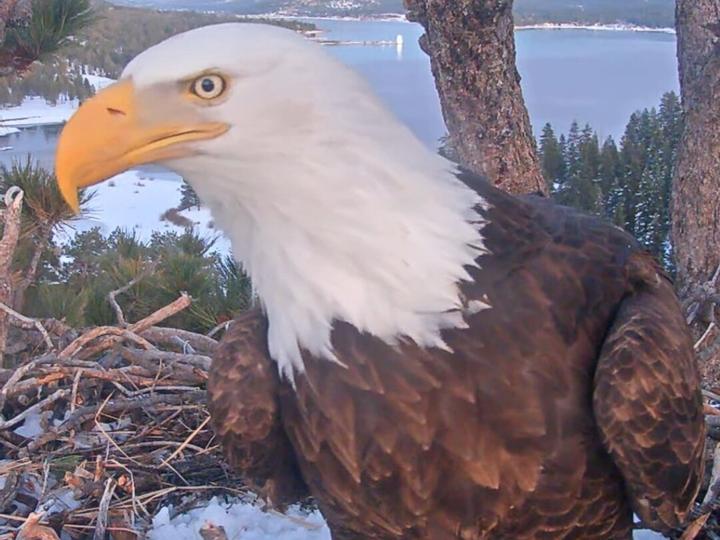
🦤 Shadow’s beak is curvier while Jackie is larger with broader shoulders. |
🐟 From juveniles to adults, bald eagles primarily consume a diet of fish. |
|
🎥 The nest livestream is accessible any time, year round for viewing. |
🪶 Six juvenile eagles have hatched, fledged and left the nest under the watchful eyes of their parents |
Content Blocks
For decades, both Big Bear Valley residents and tourists alike enjoyed the familiar sight of visiting bald eagles. Whether perched in a tree, soaring overhead or fishing from Big Bear Lake, these raptors have maintained a commanding presence.
However, Big Bear Valley was not always home to nesting bald eagles. Originally, these raptors only overwintered in the area when fishing sites further north froze over during the colder months. In February 2012, eagles Ricky and Lucy successfully incubated the first bald eagle egg to ever hatch in Big Bear Valley. Christened “Jackie,” she would fully fledge and leave her parents’ nest, but would return years later, evolving from local mascot to global sensation.
In 2018, Jackie’s first eaglets hatched on her nest camera’s livestream. That year saw the Big Bear eagles explode in popularity, turning an icon of classic Americana into a worldwide phenomenon. For eight years, Jackie and her mate, Shadow, were the only known pair of eagles raising chicks in Big Bear Valley. Tragically, Jackie died August 10, 2026, leading to uncertainty over when the area’s next mating pair would emerge.
Meet Shadow and Remembering Jackie
Jackie (2012-2026)
After emerging in early 2012, Jackie became the first ever confirmed bald eagle to hatch in Big Bear Valley. She fledged that summer, leaving her parents’ nest. Jackie wasn’t seen in Big Bear Valley for five years, returning in 2017. She claimed one of her parents’ old nests and took a mate named Mr. B. The following year, Jackie and Mr. B successfully reared one chick named Stormy. However, in summer 2018, a new male eagle appeared at the family’s nest and refused to leave. This was Shadow. He persisted and Mr. B eventually gave up trying to stand his ground and left Big Bear Valley. Jackie accepted Shadow as her new mate. Jackie has successfully reared five chicks, one with her former mate, Mr. B, and four with her current mate, Shadow. Jackie reared seven chicks, one with her first mate, Mr. B, and six with her second mate, Shadow. Jackie died in August 2026 from complications surrounding anemia.
Shadow
Shadow appeared during May 2018, perched at the edge of the nest shared by Jackie, her mate, Mr. B, and their growing eaglet, Stormy. All three attempted to drive off the new interloper, but Shadow refused to leave the area. After a series of confrontations between the adult eagles, Mr. B left Big Bear Lake while Jackie welcomed Shadow as her new mate. Since the fall of 2018, Shadow has successfully raised six juvenile eagles with Jackie which would go on to fledge and leave their parents’ nest. These eagles include Simba (2019), Spirit (2022), Sunny (2025) Gizmo (2025), Luna and Sandy (2026). Shadow was widowed in August 2026 and may begin pursuing a new mate.
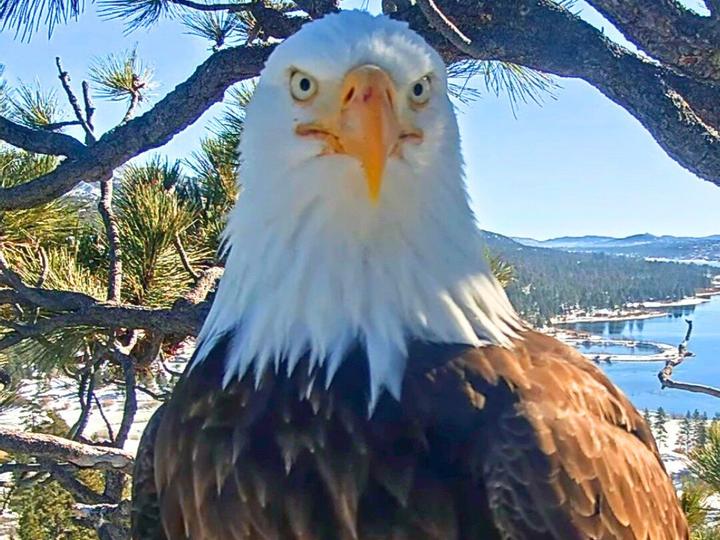
Bald Eagle Nest Livestream
The Big Bear Lake bald eagle nest camera and livestream were installed by the Friends of Big Bear Valley (FOBBV). Founded in 2001, this nonprofit works with both private and public stakeholders to preserve the 7th most biologically diverse ecosystem in the United States. Although they are largely known for the eagle cam, the organization also engages in educational, legal and fundraising activities that spearhead conservation measures throughout the 15-mile-long valley. Visit their website to engage with FOBBV’s mission.
The first camera was installed in October 2015. FOBBV hired a biological tree climber with the required federal and state permits to ascend the over 150-foot tall Jeffrey pine and mount the equipment. To avoid damaging the tree, a system of ropes and pullies shepherded the climber up about 145 feet to a spot overlooking the nest bowl. The second camera followed six years later in 2021.
Both cameras operate 24/7 and the associated livestreams are free and accessible to the public. They feature pan, tilt and zoom options to better capture nest activities and when animals, including the eagles, approach or leave the nest and nearby perch. The cameras are solar-powered and use infrared lights to capture activity at night and otherwise low-light conditions. The full camera model designation is Axis M5525-E PTZ Network outdoor camera with a 10x lens.
Best Time to Watch Eagles in Big Bear, California
Eagles and their chicks are diurnal, active most during the day, similar to humans. Fortunately, both nest cameras use infrared light to capture the eagles’ activities  during nighttime hours.
Adult eagle activity is largely dependent on whether the female has successfully laid eggs as well as whether her eggs have hatched. Viewers can tune in January each year to see Jackie potentially lay eggs and witness her and Shadow alternate incubating the clutch. If one or more eggs hatch, the livestream will capture the adults eagles rearing their young from February through the middle of summer, by which time the juvenile eagles will take flight and leave the nest.
Toward the middle of November, tune in to see the adult eagles repairing their nest. This usually lasts up through January of the next year when female eagles tends to lay the next season’s clutch.
Click here to read the full Live Big Bear Bald Eagle Nest Recap Report of activities provided by FOBBV.
Nest Location and History
Situated about 145 feet high near the top of a live Jeffrey pine, the nest overlooks the northwest shoreline and Grout Bay area of Big Bear Lake. While its exact location is kept hidden to discourage foul play, it inhabits a general forested area not far from Gray’s Peak Trailhead and the Grout Bay Picnic Area. The USDA Forest Service enacts periodic trail closures to protect the eagles’ habitat by limiting nearby human activity.
This nest was originally built in fall 2011 by Jackie’s parents, Ricky and Lucy, and was their second Big Bear Valley nest overall. It is located roughly 50 feet from the first, now-destroyed nest Jackie hatched in. Jackie’s parents raised at least one eaglet in this second nest, before relocating to a third and final nest in fall 2015. Ricky and Lucy left Big Bear Valley in mid-2016, but Jackie returned to the area in 2017 and claimed the second nest that is now her current nest where she would rear chicks until her passing in August 2026.
Bald Eagles build the largest nests of all avian species in North America. FOBBV estimates the Big Bear Lake nest is 5 1/2 feet wide and 6 feet deep. It is around 7,100 feet above sea level, making it among the highest bald eagle nests in the country by elevation.
The structure is not hollow, but consists of layered, crossed sticks up to the nest bowl, where the eggs are laid. Each season, the pair of eagles make restorations and build out new parts of their home. Sticks are sourced from surrounding trees as well as the Jeffrey Pine in which the nest sits. The eagles can easily break off twigs from dead trees with their talons. They also add “fluff,” such as grasses and reeds, around the nest bowl to soften it for their chicks.
Recent News
The Passing of Bald Eagle Jackie
[posted May 1, 2026]
Video footage emerged on July 19 of Jackie engaged in a fight with two subadult eagles on the north shoreline of Big Bear Lake. After grappling on the ground, Jackie was seen struggling in the water before coming to perch on the edge of a nearby catamaran. Local firefighters from San Bernardino County Fire Station 96 positioned themselves nearby to ward off potential predators until wildlife rescuers arrived.
 Jackie was later retrieved by the Los Angeles County San Dimas Raptor Rescue who stabilized her before transferring the injured eagle to the Ojai Raptor Center. She was designated patient 26-519. Preliminary bloodwork determined a severe case of anemia as well as kidney inflammation. Jackie received oxygen therapy, underwent a CT scan and was fitted with a tail guard to protect her tail feathers during recovery.
The day prior to Jackie's death, the Ojai Raptor Center announced a slight recovery in her packed cell volume (PCV), though it remained critically low and her health was in poor condition. Jackie died August 10, 2026 and her remains were given to the California Department of Fish and Wildlife (CDFW) to determine next steps.
Save Moon Camp Fundraiser Complete
[posted July 25, 2026]
On July 24, 2026, FOBBV published a press release announcing the success of the $10 million Save Moon Camp fundraiser thanks to over 25,000 individual donors, as well as a generous $5.5 million donation from Anna and Greg Brockman. Now, the San Bernardino Mountains Land Trust (SBMLT) will move to purchase Moon Camp from the current developers, securing this critical foraging habitat for local bald eagles and other wildlife.
 Earlier in 2026, negotiations between SBMLT and the Moon Camp developers devised the current solution. SBMLT was offered the opportunity to purchase the 62.43-acre site by July 21, 2026 for $10 million. Once the sale closes, the site will fall under the jurisdiction of the United States Forest Service. Visit savemooncamp.orgto read the full story.
The Juvenile Eagles have Fledged!
[posted June 30, 2026]
Roughly two months after Sandy and Luna hatched, the duo began branching for the first time. This experience involves the eagles moving outside the nest bowl and practicing movement between surrounding tree branches, a precursor to flight. Branching eagles intermittently flap their wings, take short hops and test the grip strength of their talons. Sandy branched first on June 2, followed by Luna three days later. 
After a little under one month of successful branching, Sandy fledged on June 28, taking flight for the first time from the nest. Luna followed the next day, fledging on the full moon. Typically, juvenile eagles remain in the locality they hatched for the rest of summer through the end of autumn. However, the sheer size of the forest can make it difficult to determine when Sandy or Luna might leave the area.
Nesting Season Timeline

The bald eagle nesting season varies across North America. In Big Bear Valley, nest building and repairs start in November and continue through the end of the year. FOBBV begins monitoring the nesting season on September 1 to record any additional activity from adult eagles and account for any anomalies. Since the pair has consistently returned to the same nest, they focus on repairing the structure from year to year, usually beginning in mid-November.
The latitude of the nesting region as well as the amount of daylight hours determine what months a bald eagle lays her eggs. Usually, as nests are built further south, eagles lay eggs earlier in the year. Jackie was remarkably consistent, with most, though not all, of her clutches laid during January. Nonetheless, there are still cases of other bald eagles in Southern California that have laid eggs in April. FOBBV notes the average egg incubation period lasts 35 to 41 days, while the time from hatching through fledging can last anywhere from 10 to 14 weeks. The organization also notes another four to 12 weeks is often required for the juvenile eagle to learn basic survival skills from its parents.
Chicks that hatch during winter have a better chance at surviving subsequent winters on their own. This time is invaluable for bald eagle parents to demonstrate foraging behavior for their young, usually hunting, fishing and general flight activities. These birds evolved to raise chicks in below-freezing temperatures, having developed nesting and incubation practices to ward against snow, high winds and freezing rain. Egg loss does often occur due to inclement weather, but hatched chicks have a better survival rate against the chill of winter compared to the heat of summer.
In Big Bear Valley, the bald eagle nesting season ends when juvenile eagles fledge and leave the nest in mid-summer. They might remain in the area for up to three months before departing the region altogether. Some eagles, much like Jackie, may return to the location where they first hatched to raise offspring of their own. To read the full history of the bald eagle nesting season in Big Bear Valley, visit the FOBBV history page.
Glossary of Terms
See below for a list of common words used to describe bald eagle activities. These terms aren’t exclusive to eagles; many raptor species engage in the same behavior.
Clutch: A group of eggs. Bald eagles lay between two and and three eggs, rarely four, in a clutch.
Diurnal: Describes a species that is usually active during the day and is inactive at night. Bald eagles are diurnal, much like humans.
Feaking: The process of rubbing the beak against another surface to remove bits of food or debris. This also keeps an eagle’s beak sharp as it grows during their life.
Fledge: Denote when a young bird has developed feathers and may commit to flight. Eagles that fledge are sometimes still dependent on their parents for food, even if they are fully capable of flying. 
Fluff: Soft, lightweight materials birds use to line their nests in preparation for egg laying. Eagles in Big Bear Valley often use plant fibers, such as grasses or reeds.
FOBBV: Friends of Big Bear Valley, a nonprofit that maintains the eagle cams and several other conservation activities.
Plumage: Refers to the feathers that cover a bird's body. During its life, a bird might exhibit various feather colors, patterns and arrangements.
Preening: The act of grooming or otherwise maintaining a bird’s feathers using the beak. Many birds also have an uropygial gland to aid them during preening.
Raptor: Another term for bird of prey, carnivorous avians that feed on, and often hunt, other animals.
Snag: A standing, dead tree. Stags provide eagles with branches for nesting and perches to observe prey.
Talons: Sharp, curved claws, at the end of a raptor’s feet. Analogous to toenails in humans.
Uropygial gland: Located near the base of a bird’s tail, this organ secretes oils that aid in feather maintenance during preening.
Frequently Asked Questions
Can I visit Jackie and Shadow at Big Bear Lake?
The Eagles’ exact nesting location is kept hidden to discourage foul play. However, people may occasionally catch a glimpse of either parent fishing in Big Bear Lake or perched on a nearby tree. Visit the Big Bear Alpine Zoo to see captive bald eagles that have been rescued from debilitating injuries.
Where can I learn more about the eagles?
Both the Friends of Big Bear Valley website and associated Facebook page have historical info, general facts and recent updates concerning eagles sighted in Big Bear Valley.
Do bald eagles mate for life?
Generally, yes, but eagles often find new mates if their previous mate dies. It is uncommon for eagles to leave for a new mate when both original partners are still alive. Jackie represented one of these instances when she left her first mate, Mr. B, in 2018 after Shadow appeared at the couples’ nest and refused to leave. After Jackie's passing in August 2026, Shadow may have begun searching for a new mate.
What happened to Jackie?
Jackie was reported to have engaged in a fight with two subadult bald eagles at Dana Point Park on Big Bear Lake's north shore on July 19, 2026. She was later picked up by the Los Angeles County San Dimas Raptor Rescue and transferred to the Ojai Raptor Center to receive treatment. Despite some initial progress, Jackie died August 10. It is unlikely her death was a result of the initial fight, which left her relatively unscathed. Instead, Jackie had become severely anemic with inflammation in her kidneys.